Learn task-compatible futures
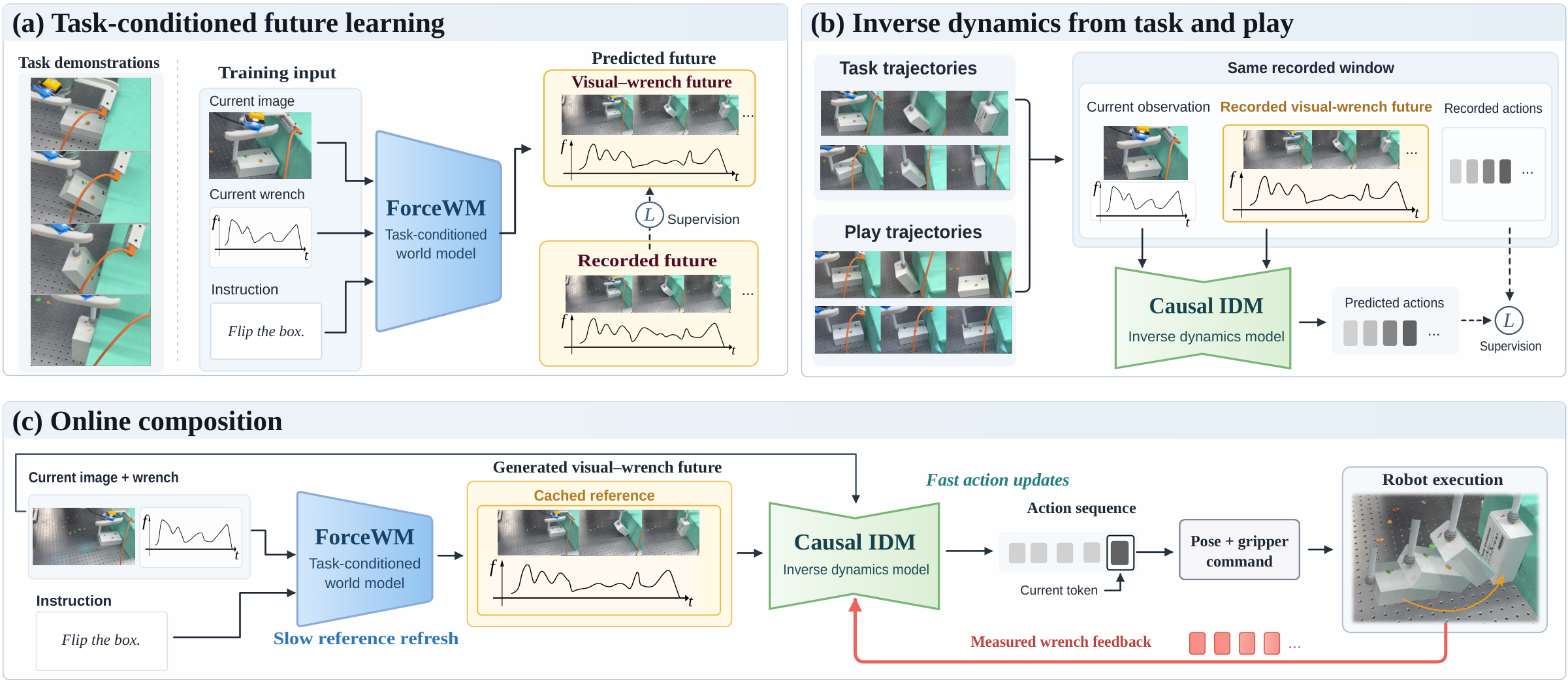
ForceWM learns from successful demonstrations to jointly generate future wrist-camera video and six-axis wrench trajectories. The current observation and task instruction guide the interaction it predicts.
A force world action model
A play trajectory need not complete a task to teach how actions change contact.
ForceWAM learns task-compatible futures from demonstrations and execution from task and play.
Success gains from task-agnostic play
Mean success across four conditions
Joint future prediction, reactive execution
The play insight
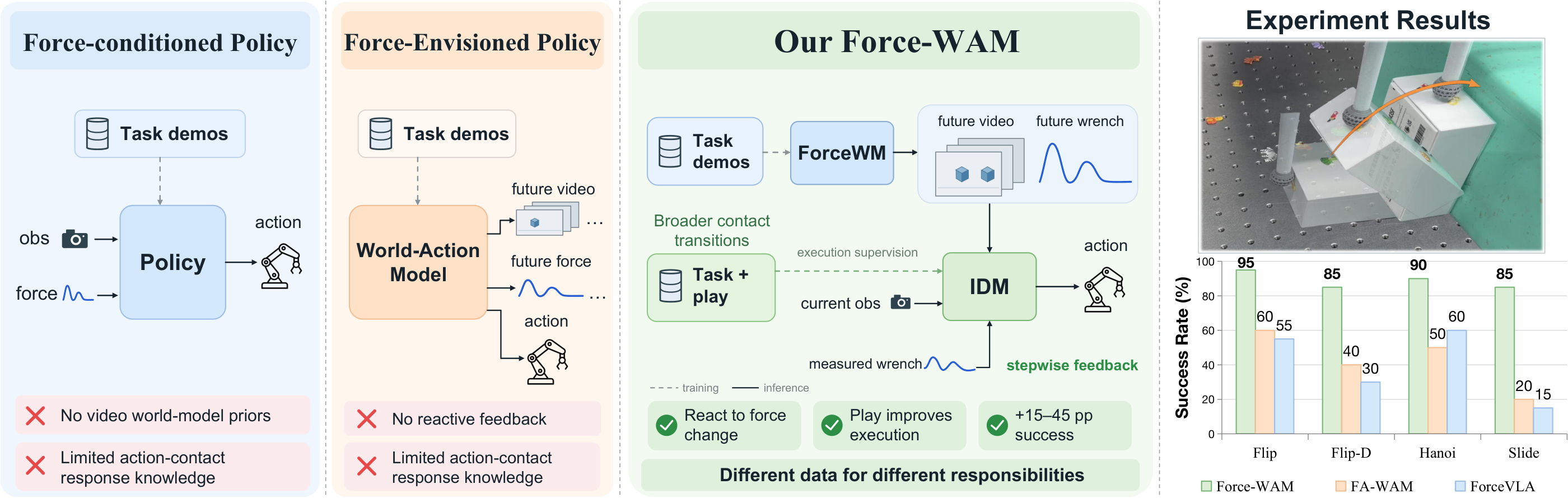
Contact-rich manipulation requires learning both which interactions accomplish a task and how to realize them as contact conditions evolve. Successful demonstrations provide examples of task-compatible motion and force, but may offer limited coverage of local action–contact responses. A successful push, for example, need not reveal how force changes when the robot presses farther or backs away.
Task-agnostic play provides complementary experience through exploratory pressing, sliding, and release. These interactions need not complete a task to reveal useful relationships between actions, motion, and contact. This raises a central question: how can experience collected without the downstream task instruction help a robot execute the interactions that the task requires?
Our insight is to decompose contact-rich manipulation into two complementary learning problems: predicting task-compatible interactions and learning the actions that realize them. ForceWAM connects the two through visual–wrench futures. ForceWM learns task-compatible futures from successful demonstrations, jointly describing anticipated motion and contact loading. An inverse dynamics model learns from both demonstrations and play to predict actions conditioned on each segment’s recorded visual–wrench future. At deployment, generated futures supply task-conditioned references, while newly measured wrench feedback supports reactive action updates. This allows play to contribute to contact execution even when its trajectories do not demonstrate a task solution.
Expert demonstrations show how to complete contact-rich tasks, but provide limited coverage of how interaction forces respond to different actions. Task-agnostic play provides broader experience of contact dynamics without specifying task goals. To fully leverage these two types of data, we introduce ForceWAM, a force world action model that decouples knowledge of task-compatible interaction outcomes from knowledge of how local actions change contact. A world model learns from successful demonstrations to jointly predict future video and six-axis force/torque trajectories. Together, these futures describe the expected evolution of motion and contact during the task. A separate inverse dynamics model (IDM) learns from both task and play, mapping current observations and recorded visual-wrench futures to their associated robot actions. Play data thus provide knowledge of force responses for goal-directed execution. At deployment, the IDM reactively translates generated futures into actions, reusing them with fresh wrench feedback between world-model updates. Across real-robot force-regulated sliding, box flipping with and without disturbances, and ring placement, ForceWAM achieves 85–95% mean success, surpassing world-modeling and reactive baselines. Our experiments further show that adding task-agnostic play data improves success by 15–45 percentage points, demonstrating its value for learning contact-rich execution.
Method
This division of supervision gives task demonstrations and play distinct roles: demonstrations define task-compatible visual-wrench futures, while both sources teach the actions associated with observed outcomes.
ForceWM learns from successful demonstrations to jointly generate future wrist-camera video and six-axis wrench trajectories. The current observation and task instruction guide the interaction it predicts.
The inverse dynamics model learns from current observations, recorded visual-wrench futures, and the associated actions. Play expands this execution supervision with interactions that need not demonstrate task success.
ForceWM supplies a task-compatible future to the IDM trained on task and play. The causal, slow–fast executor reuses that future while updating actions with newly measured wrench feedback.
Condition
Current observation
+ Recorded visual-wrench future
Action target
Action sequence from
the same recorded segment
Real-robot experiments
Three task families test sustained force regulation, controlled rotation, disturbance response, and precise seating. ForceWAM achieves the highest reported mean success in each condition.
01 / SLIDE
85%Complete the sliding path while satisfying the 5–15 N contact-force criterion, targeting 10 N.
02 / FLIP
95%Maintain tool–box contact and a controlled pushing force as the box rotates over its edge.
03 / FLIP-D
85%Complete box flipping when an external push changes the contact state during execution.
04 / HANOI
90%Place a held ring onto a 10 mm pole, using contact feedback during alignment and seating.
| Method | Slide | Flip | Flip-D | Hanoi |
|---|---|---|---|---|
| RDP | 15 | 40 | 30 | 45 |
| ImplicitRDP | 20 | 45 | 25 | 55 |
| ImplicitRDP + Play | 10 | 25 | 10 | 30 |
| ForceVLA | 15 | 55 | 30 | 60 |
| Cosmos Policy | 15 | 40 | 30 | 60 |
| Cosmos Policy + Play | 10 | 20 | 15 | 40 |
| Fast-WAM | 10 | 50 | 25 | 65 |
| FA-WAM | 20 | 60 | 40 | 50 |
| π0.5 | 10 | 40 | 20 | 60 |
| ForceWAM Task-only IDM | 40 | 75 | 65 | 75 |
| ForceWAM Full-play IDM | 85 | 95 | 85 | 90 |
Each evaluation run uses 20 trials per task. Values are reported mean success rates, not individual rollout counts. All methods use the same safety limits and controller interface. “+ Play” denotes additional action-labeled play data.
Testing the play insight
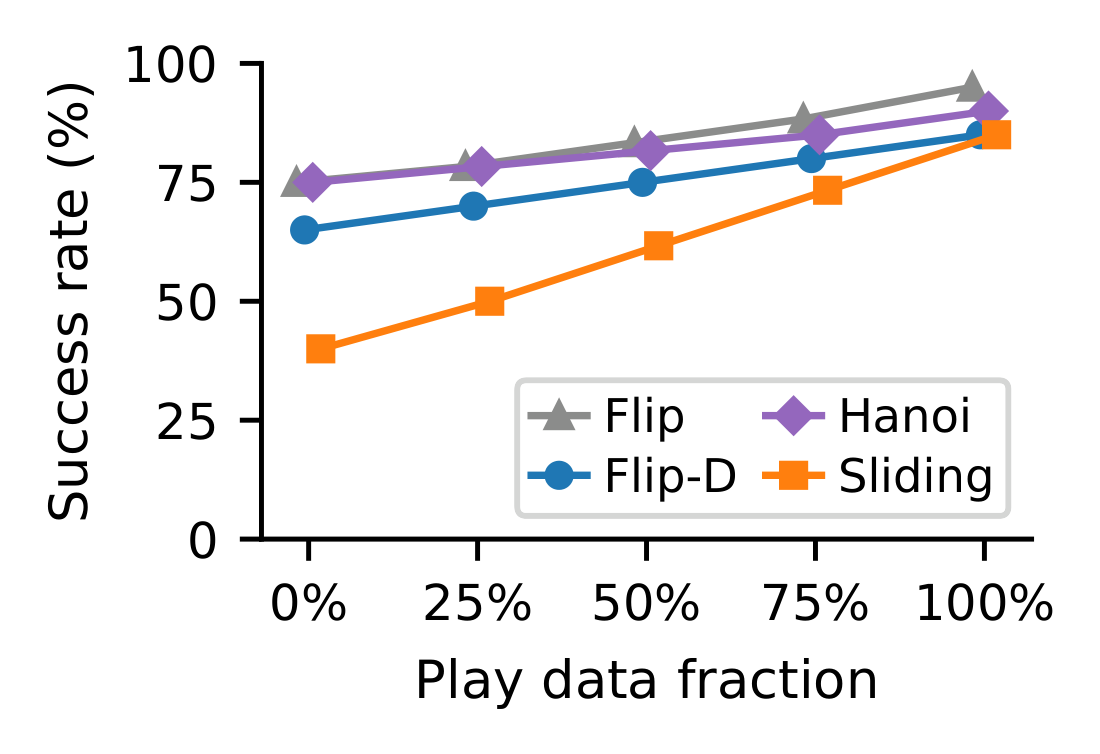
We keep task demonstrations, ForceWM, and IDM optimizer updates fixed while increasing the play data used for execution learning. Each task family has 200 demonstrations and a pool of 200 play episodes; Flip and Flip-D share their training data.
Adding the full play pool improves success by 15–45 percentage points. Sliding improves from 40% to 85%. These gains come from updating the executor’s training data, with the same task-trained model supplying its future conditions.
Adding play reduces success for the evaluated ImplicitRDP and Cosmos Policy variants in all four conditions (main comparison). Together with ForceWAM’s gains, these results support assigning task-compatible future learning and local response learning to separate objectives.
Inside the world model
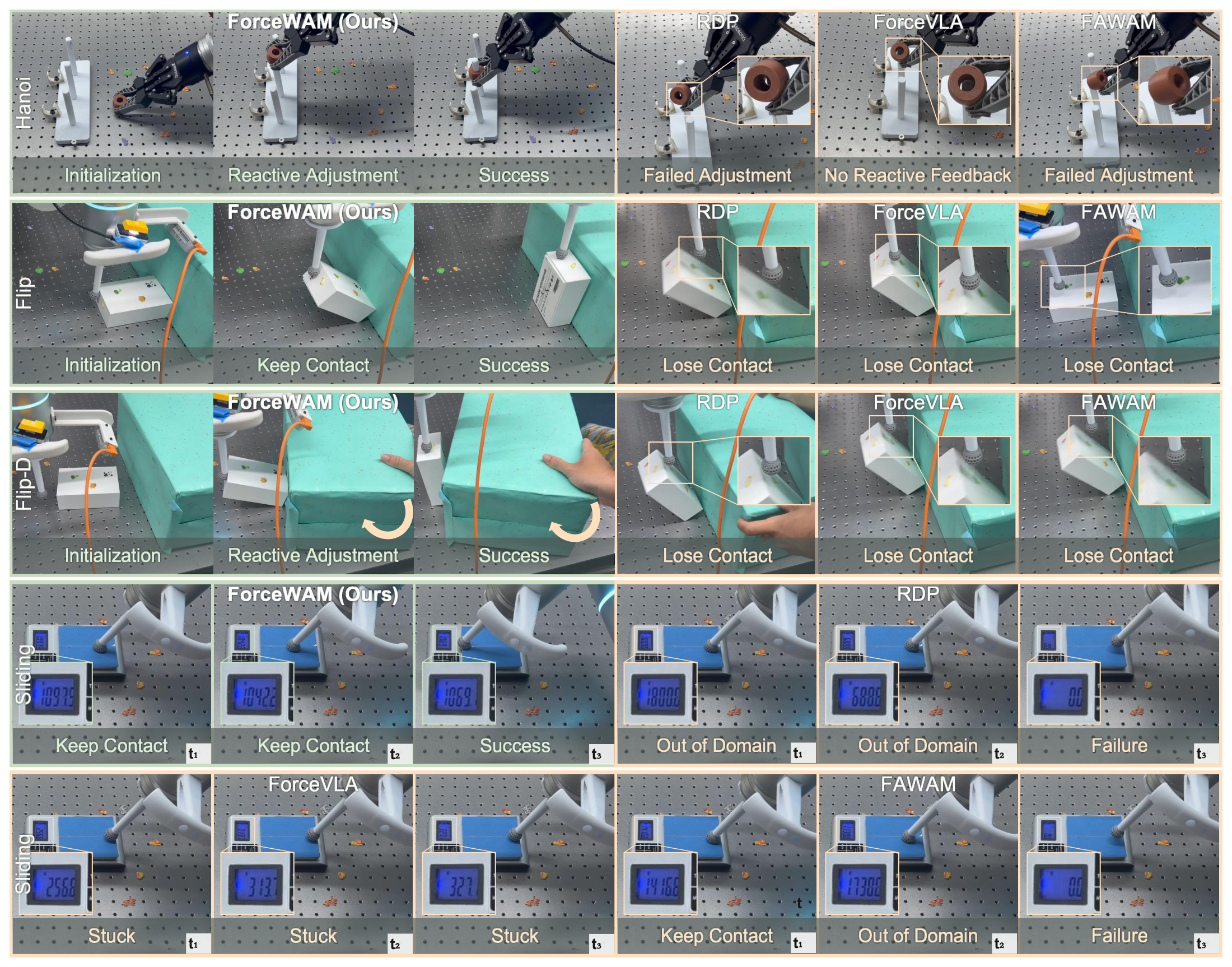
During closed-loop box flipping, ForceWM predicts both the changing tool–object geometry and the contact loading that accompanies it: approach, rotation, and separation.
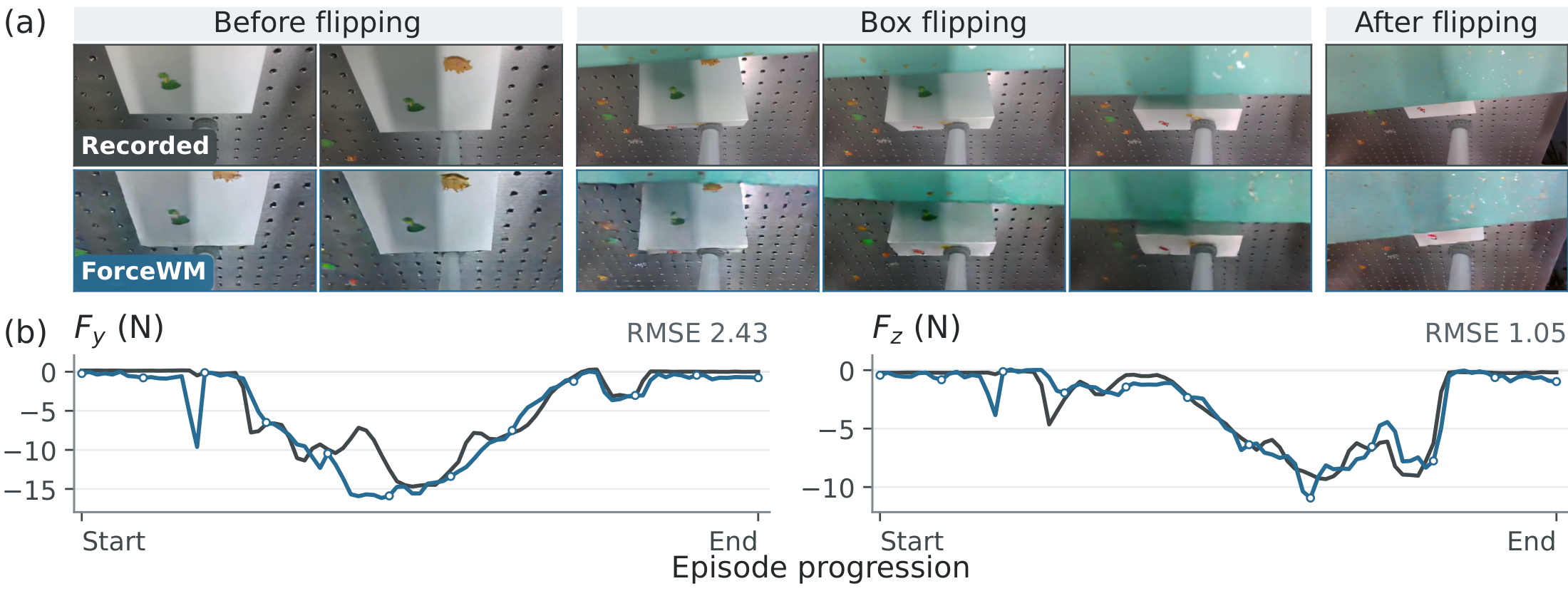
All variants below retain the current wrist image and measured wrench feedback, use task + play data, and are trained independently. Joint visual-wrench conditioning gives the best reported mean success across all four conditions.
| Future conditioning | Slide | Flip | Flip-D | Hanoi |
|---|---|---|---|---|
| Visual + wrench | 85 | 95 | 85 | 90 |
| Visual only | 15 | 40 | 30 | 70 |
| Wrench only | 20 | 30 | 25 | 30 |
| No future conditioning | 15 | 30 | 35 | 50 |
| Visual + wrench, no augmentation | 65 | 80 | 70 | 75 |
See it in action
Twelve real-robot rollouts across four evaluation conditions. Select a task to explore the recordings. Playback speed is indicated in each video.
Maintain contact while moving along the scale. The task targets 10 N, with a 5–15 N contact-force criterion.
Coordinate motion and contact force to carry the box over its edge.
Six recordings show contact-rich execution with externally applied perturbations.
Reference
If you find this work useful, please consider citing it.
@misc{xu2026forcewamdecouplingfutureresponse,
  title = {ForceWAM: Decoupling Future and Response Learning from Demo and Play Data for Contact-Rich Manipulation},
  author = {Zijun Xu and Wendi Chen and Xinkai Wang and Jiachen Zou and Hongjin Chen and Hairuo Liu and Bokai Lin and Shihao Ma and Ke Ma and Zhiwei Zhang and Zhuohao Yan and Ke Wu and Haoming Song and Xueqi Li and Chuan Wen and Jieru Zhao and Wenchao Ding and Cewu Lu and Lixin Yang},
  year = {2026},
  eprint = {2610.18852},
  archivePrefix = {arXiv},
  primaryClass = {cs.RO},
  url = {https://arxiv.org/abs/2610.18852},
}